- calendar_today September 1, 2025
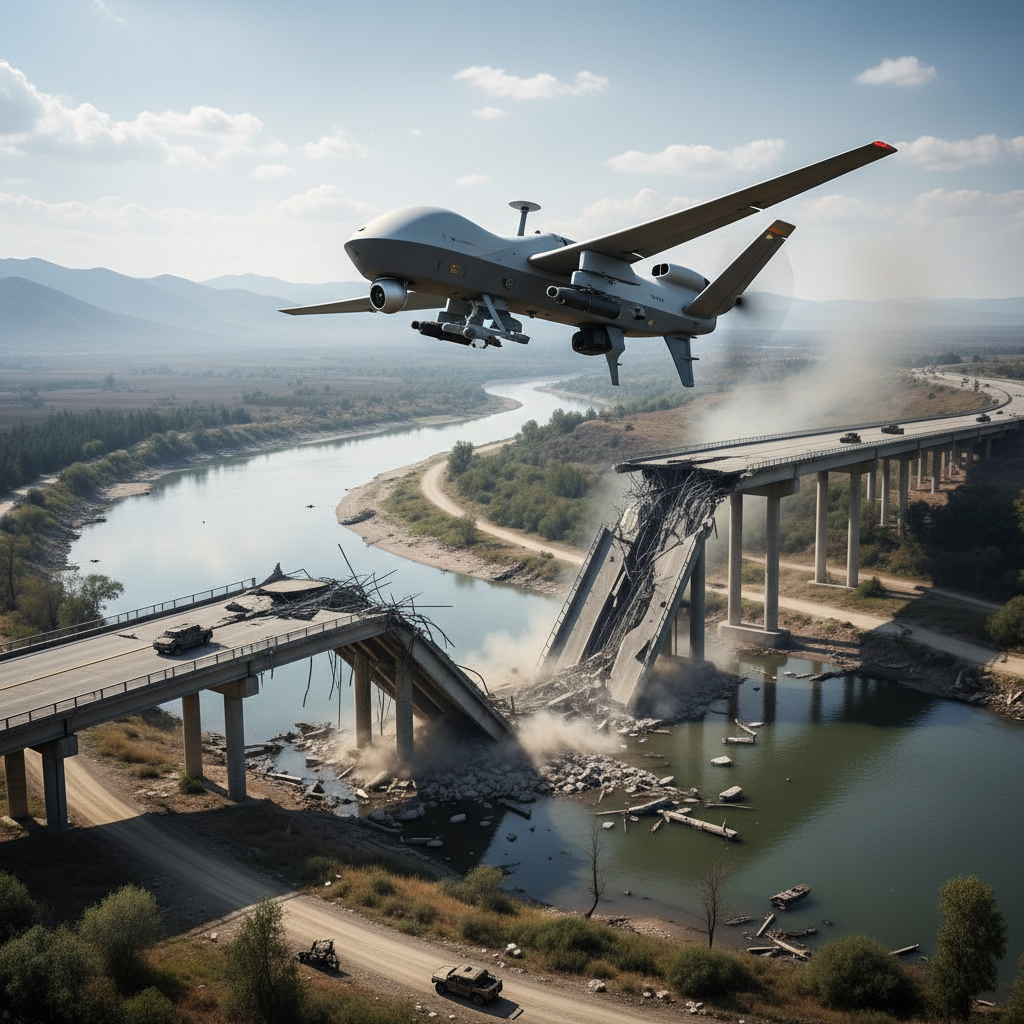
Two bridges in Russia’s Belgorod region have been blown up by Ukraine’s military in an operation that both shows their increasing battlefield effectiveness and the growing potency of low-cost first-person-view (FPV) drones. The 58th Separate Motorized Infantry Brigade reported the attacks on July 8, claiming to have targeted a store of mines and ammunition under the bridges used by the Russian military to replenish its stocks. The bridges, which straddle the Ukrainian border with the Kharkiv region, were mined by the Russians to prepare for their detonation in the event of a Ukrainian attack.
The Popular Resistance of Ukraine
According to the Ukrainian military, the two bridges were being used by the Russians to resupply their forces operating near the frontlines. The units were operating inside Russian territory but near the border with Ukraine. Because of their proximity to the frontier, the Ukrainian military has been able to use drones to monitor developments in real time.
The Russian military has also set up surveillance drones in Ukraine in a sign of the new warfare now being waged across the border. According to a representative of the 58th Brigade, the unit had been watching the area when it spotted unusual activity around one of the bridges.
“It became clear that something was going on there,” the spokesperson said. Standard drones could not be used to investigate because they would lose signal under the bridge. This is where the unit used an FPV drone, which uses a fiber optics system to send real-time images directly to the operator. In this case, they sent out one of their modified Chinese-made DJI drones to get a look inside.
The Cost of Doing Business
They soon found themselves staring at a cache of anti-tank mines and ammunition under the bridge. “We saw the mines, and we struck,” the brigade’s spokesperson said. Footage of the attack, which was published by the brigade, shows a drone approaching the bridge before it strikes the cache. As it does so, the drone detonates in a huge explosion. A second camera, likely also controlled by the drone, captured the blast from a distance.
CNN geolocated the bridge to the Belgorod region, which sits just across the Ukrainian border from the Kharkiv region. The unit then investigated another bridge in the area, discovering that it was also mined and waiting for the order to blow up. “(We) saw an opportunity and took it,” the brigade said. A second drone was deployed to detonate the explosives, and the drone’s camera was used to record a second powerful blast.
Remarkably, the drones used to trigger the explosions were modified DJI drones worth between 25,000 and 30,000 Ukrainian hryvnias, or between $600 and $725. In comparison, each HIMARS multiple rocket launcher used by Ukraine to strike targets in Russia costs millions of dollars. Rockets are also in the tens of thousands of dollars each. These systems have allowed Ukraine to hit targets as far inside Russian territory as the Kursk region. The HIMARS system was developed by the U.S. military in order to fire on targets more than 60 miles away.
Another Victim of FPV Drones
Russia’s attack on Ukraine has accelerated the development of low-cost drones. FPV drones have been a key part of that trend, with many being built by volunteers using components purchased on the open market. They are essentially video games controllers with a built-in camera. Ukraine has used FPV drones before in spectacular attacks. In June, Ukrainian forces used small drones smuggled into Russia to destroy or damage dozens of Russian aircraft operating at its airfields.
“The types of operations show how even modest technology can achieve outsized effects when used creatively,” military analyst Mykola Bielieskov said. Drones have allowed Ukraine to hit its targets deep inside Russia without using up the limited supply of Western-provided munitions. Moscow and Kyiv have agreed to a truce in some places in the battle for Donbas, but Ukrainian President Volodymyr Zelensky says Russia has continued its near-daily missile and drone attacks on Ukrainian cities. Putin has also signaled that there will be no talks of a ceasefire until the Russians complete their offensive, which is grinding forward in eastern Ukraine. The battle for Donbas is also now taking its toll on Ukraine, which is facing increasing challenges in key areas.
In that context, the news of the attack was a rare victory for Ukraine and provided a much-needed boost to the battered country. Russia has not said anything about the attack on the bridges. However, losing the structures will make it more difficult for Moscow to supply its forces in the Belgorod region, which will hurt logistics as the units operating along the Ukrainian border will have their supply lines disrupted. The story of the bridges also serves to illustrate something that is becoming increasingly apparent to Ukraine’s military. That is that it needs to improvise to stay competitive. While Ukraine is using high-tech systems, Western aid can only go so far. And with Russia’s army also relying on attrition and its numerical advantages, Kyiv has had to do something with what it has. For the Ukrainian military, that means repurposing and modifying drones to be more effective against its enemy. “The value of these drones cannot be overstated,” the 58th Brigade representative said. “They allow us to achieve results that would otherwise require weapons we don’t have.”