- calendar_today August 12, 2025
.
Washington and New Delhi had for more than two decades considered each other an unusually successful strategic partnership in the post–Cold War period. The confidence built over years of joint diplomatic and defense initiatives now risks its most serious challenge in years as the two countries accuse each other of being disloyal.
“The trust is gone,” said Evan Feigenbaum, the director of the Carnegie Endowment for International Peace’s South Asia program. “We’re in a situation in the U.S.-India relationship where the premises and assumptions of the last 25 years that everybody worked very hard to build, including the president in his first term, have just come completely unraveled.”
Trump announced tariffs on a range of Indian goods in May after India continued to purchase discounted Russian crude oil even after Russia invaded Ukraine. The president’s 25 percent tariff is scheduled to double to 50 percent on Aug. 27. Instead of the desired change in India’s purchasing decisions, the White House’s move has only pushed New Delhi to cozy up to Moscow and even Beijing.
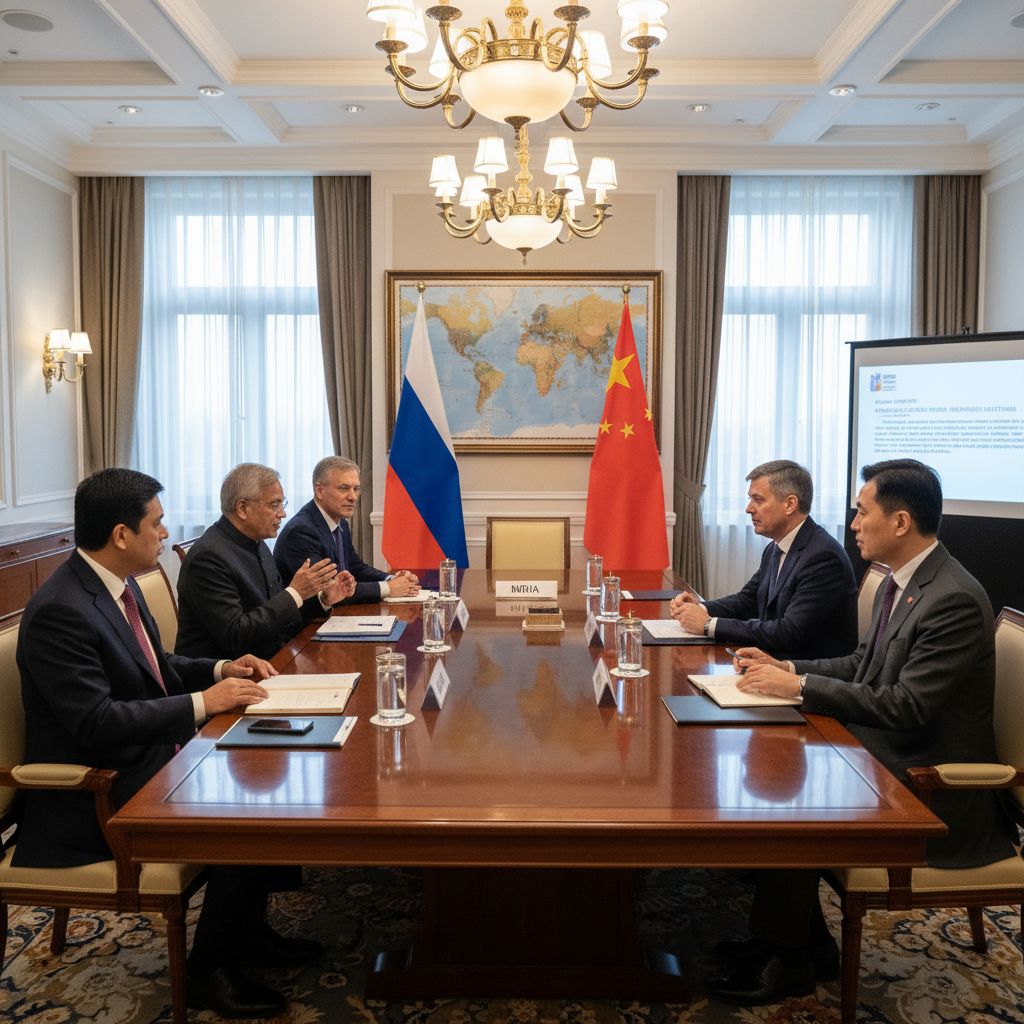
India’s national security adviser, Ajit Doval, visited Moscow last week, and the country’s foreign minister, Subrahmanyam Jaishankar, met with senior officials there earlier this month. Just after that, Chinese Foreign Minister Wang Yi finished talks in New Delhi. Indian Prime Minister Narendra Modi will visit China for the first time in more than seven years later this year, and Russian President Vladimir Putin is likely to receive him in Moscow before the end of the year. Analysts say these gestures are more than symbolic.
“There is a new narrative with Modi playing up India’s self-interest and not taking dictation from the United States. Indian public opinion is solidifying around this,” Feigenbaum said. “They’re signaling very clearly that they view that as interference in India’s foreign policy, and they are not going to put up with it.”
India took some time after the war in Ukraine started, but state-owned refiners are now again buying Russian oil, attracted by discounts of six to seven percent on benchmark Urals crude. As a result, Indian imports from Russia have jumped to 35 percent of total crude purchases, from a mere 0.2 percent before the war in Ukraine. Russia, for its part, is ready to offer more. Deputy Prime Minister Denis Manturov was quoted by the Interfax news agency as saying: “Russia will continue to supply crude, oil products, thermal and coking coal to India. The Indian market is also interesting in terms of the export of Russian LNG, so there is potential there.”
And more than that. Indian and Russian media this week reported that New Delhi and Moscow are to resume production-sharing talks for India’s hydrocarbon exploration on the Russian continental shelf after a gap of 15 years. It would be the next significant step in strategic ties between the two that would be a clear sign to the U.S.
On the economic front, Finance Minister Nirmala Sitharaman has repeatedly brushed off Washington’s demands to show willingness to bend with respect to India’s proposed digital-services tax and suggested that the country’s external reserves of $611 billion are more than enough.
Explaining New Delhi’s Moves
Michael Kugelman, senior associate for South Asia at the Washington-based Center for Strategic and International Studies, said that Trump’s tariffs were only one of many factors prompting a significant diplomatic shift by India. “We’ve seen indications for almost a year of India wanting to ease tensions with China and strengthen relations, mainly for economic reasons. But the Trump administration’s policies have made India want to move even more quickly,” he said.
Much of New Delhi’s diplomacy at the moment, Kugelman said, “may be more performative theater than substance.” Feigenbaum agreed: “India is going to double down on some aspects of its economic and defense relationship with Russia — and those parts are not performative.”
It’s also worth noting that New Delhi had already been limiting its military purchases from Russia before the Ukraine war, instead turning to U.S., French, and Israeli arms. But once Russia’s invasion began, New Delhi went big on its energy trade with Moscow. Kugelman described this as a reward for Russia but also as a vindication of India’s position that “the U.S. can’t be trusted, whereas Russia can — because Russia is always going to be there for India no matter what.”
The result for Modi, in the long term, may be that India’s prime minister has been able to not only defend himself against charges of being “soft” on Russia but to instead present himself domestically as taking a hard line in defense of India’s sovereignty.
A Loss of Trust?
India and the U.S. made progress in a range of areas in their relationship after the normalization of ties in the early 2000s. The U.S.-India civil nuclear deal in 2008, for example, allowed New Delhi access to U.S. fuel and technology for civilian energy despite its status as a non-signatory to the Non-Proliferation Treaty.
At the time, Washington was willing to work with India on some issues but also willing to “agree to disagree” on others. When India and Pakistan signed the 1972 Simla Agreement, the U.S. still went ahead with its New Delhi Embassy even as it closed down the one in Islamabad.
Today, some of the same disagreements between India and the U.S. are seen by both sides as threats to more important aspects of cooperation, in particular defense and intelligence cooperation. That represents a significant deterioration of the trust built up over decades.