- calendar_today August 17, 2025
Fantastic Four Delivers Believable Heroes in a Cartoonish World
Marvel’s The Fantastic Four: First Steps is a pretty movie, a breezy and cheeky reboot of one of the company’s earliest superhero teams. With a roster of strong actors—particularly Pedro Pascal and Ebon Moss-Bachrach—it leans hard into its nostalgic 1960s palette, even borrowing cheekily from that decade’s pop-art sensibility. But for all its retro style and earnestness, it never really escalates or emotionally ratchets up, and as a result, it doesn’t feel as memorable as it should.
Producer Kevin Feige was right to call this a “no-homework-required” movie. As the Marvel Cinematic Universe has expanded and grown more unwieldy, a movie that doesn’t demand foreknowledge of the many multiverses, cameos, and spin-offs is a welcome thing. This latest iteration of Reed Richards, Sue Storm, Johnny Storm, and Ben Grimm eschews the bloat and continuity complexities of the recent live-action films (or the 2000s-era cartoon) to tell a self-contained, simple story. It’s a good, earnest, and largely well-executed movie—and, also, sometimes too simple.
The Fantastic Four: First Steps opens with a staged talk show, hosted by Mark Gatiss in a sparkling mock-turtleneck. As his “program” provides convenient exposition to fill in for those who don’t remember exactly how these four people became this specific version of the Fantastic Four, we flash back four years to when their original superpowered space mission exposed them to radiation that altered their DNA. Reed (played with smarts and levity by Pedro Pascal) gained the ability to stretch his body and limbs like rubber. Vanessa Kirby’s Sue can turn invisible and project a force field. Joseph Quinn’s Johnny becomes the Human Torch, able to spontaneously combust and fly. And Ebon Moss-Bachrach’s Ben Grimm became The Thing—a rock-covered, giant blue behemoth with superstrength.
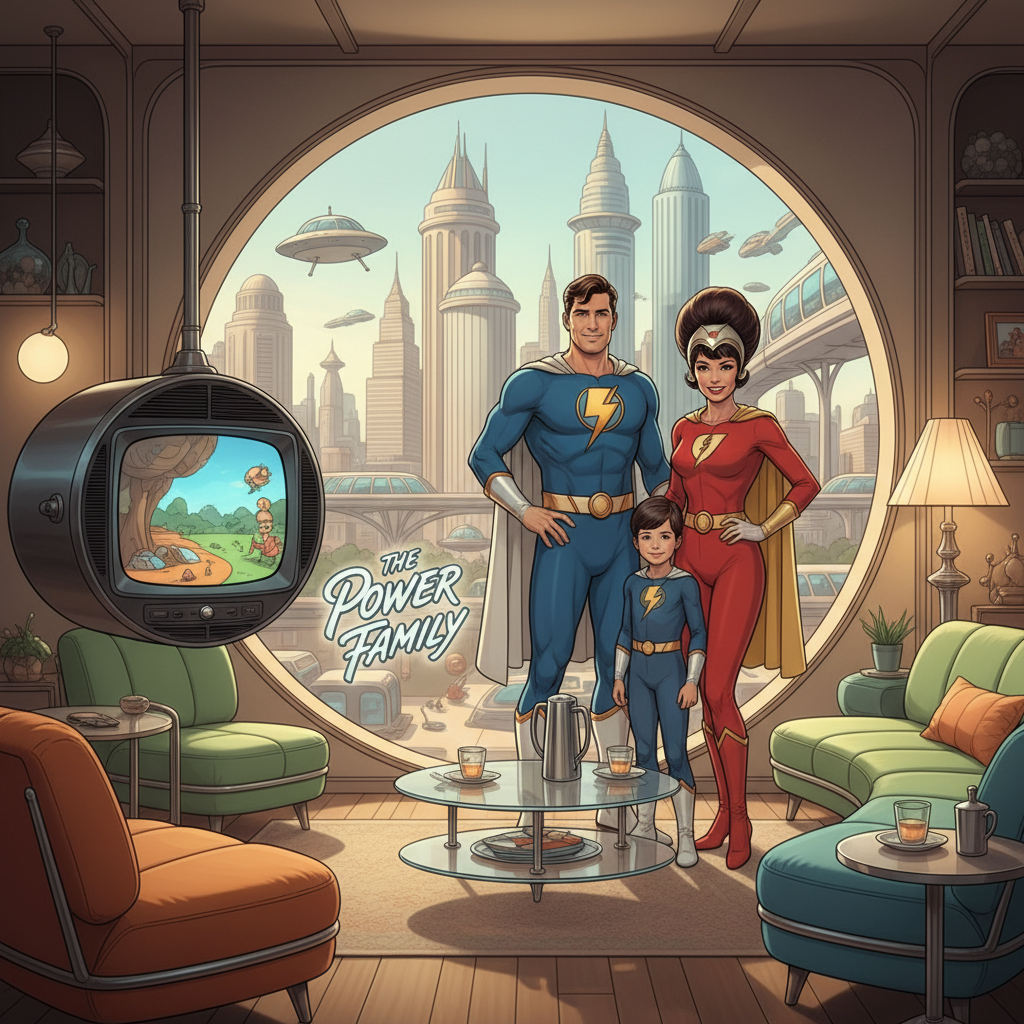
And now, the four live together (seemingly) in their own mid-century modernist space compound with its own flying cars, chalkboard equations, and tiny toddler robot house servant named H.E.R.B.I.E. Everything in First Steps is thoroughly 1960s retro-futurism: square TV sets, no cellphones, and an almost antiseptically bright optimism to its world-building. It’s hard not to look at their goofy old-school technology and how they use it and not feel like one of Marvel’s early comics has materialized onscreen. It also gives the world the uncanny sense of a decades-old Saturday morning cartoon.
It’s charming—and like a lot of things in the film, suggests something bigger and more interesting than is ever really onscreen. But it also underscores how light on its feet this particular Fantastic Four movie feels. The underpinning theme of First Steps is, well, family. Sue is pregnant, and in the early moments of the film, Reed is nervous, charmingly so. He’s getting anxious about the responsibility of fatherhood, so in one cutely stilted bit of exposition, he has H.E.R.B.I.E. read him a list of infant-proofing updates to make to their home and his nearby science lab. Johnny and Ben form a silly kind of older brother/little brother rapport, bickering and clowning their way through the action, but they’re also clearly feeling their duties as future uncles. It’s a family unit that is almost shockingly tight, closer in some ways than a nuclear family should be.
But of course, this specific Fantastic Four family is soon broken up by an onrushing spacefaring menace. Galactus, a big armored guy with glowing eyes, is on a collision course with Earth. A planet-eater who views worlds as temporary sustenance on a grander journey, Galactus doesn’t intend to let Earth live. To warn it of his arrival, Galactus sends a herald—this time, a sylphlike silver-skinned woman in motion-capture acting played by Julia Garner.
The Silver Surfer appears in a groovy, heat-vapor cloud and swoops in all sleek menace. After she’s finished doing her job, she becomes an instant fixation for Johnny, the object of what can only be described as puppy dog lust. (I’ll admit: Julia Garner as the Silver Surfer made me like the movie a little more.)
But the actual action itself is rather tame. The heroes race after Galactus into space, and the heroes do their best to avoid Surfer’s cosmic attacks. The visuals are bright, the bursts of light emanate a retro phosphorescence (lightning cracks, explosions whoosh), and even the chase through the starscape has a comic-book quality to it. The film’s big third-act reveal—that Sue is in labor while they’re fighting in space—has an odd sense of detachment. Pregnancy and impending planetary death go hand in hand, at least in this movie, and in a sickly hue of primary colors. It’s an oddly bloodless brand of Marvel spectacle.
What is the problem with this movie? There are moments of sincerity and sweetness, but they get lost in all the pastel softness. The stakes are never really high. When the fate of the Earth is at risk, even Galactus is often reduced to a silly insect in the film’s dialogue. The tone wavers between cringeworthy humor and an earnest sincerity that suggests a more heartfelt story under the surface. But even when there’s an actual, real moment of human drama, it feels oddly quiet for a Marvel movie. First Steps has, by design, simplified the complex and sometimes silly mythos around the Fantastic Four, but it has also taken the emotional core of the characters with it.
It’s a low-stakes children’s adventure story for much of its runtime, when it could be a more grown-up affair. What Marvel’s The Fantastic Four: First Steps lacks in dramatic oomph, it makes up for in being simply a good, fun, nostalgically enjoyable Marvel movie. It’s big and goofy and hits all the right beats, and Pascal and Moss-Bachrach are just excellent together. If you want to lighten your Marvel Cinematic Universe intake with something relatively lighthearted and old-school, look no further. But if you’re in the mood for something more intense, maybe just rewatch The Thing instead.