AI-generated illustration; not a photograph of the reported event.
- calendar_today October 8, 2026
The IceCube Project: A Landmark in Antarctic Science
At the South Pole, a unique scientific venture is unfolding beneath the frozen surface. Led by researchers from the University of Wisconsin-Madison, the IceCube Neutrino Observatory seeks to decipher some of the universe’s deepest mysteries by detecting elusive particles known as neutrinos. This project, managed by UW physics professor Francis Halzen as principal investigator, exemplifies the scale and ambition of "Big Science"—capable of catalyzing major leaps in human knowledge about the cosmos.
Design and Construction of the Neutrino Observatory
The IceCube project is a $270 million international effort, with $242 million in funding from the National Science Foundation and $30 million contributed by partners in Germany and Sweden, as well as participating institutions in Belgium, Japan, New Zealand, and the UK. More than 400 scientists and engineers are involved. During the Antarctic summer (November to mid-February), about 100 team members work on-site at South Pole Station, while a skeleton crew maintains year-round operations.
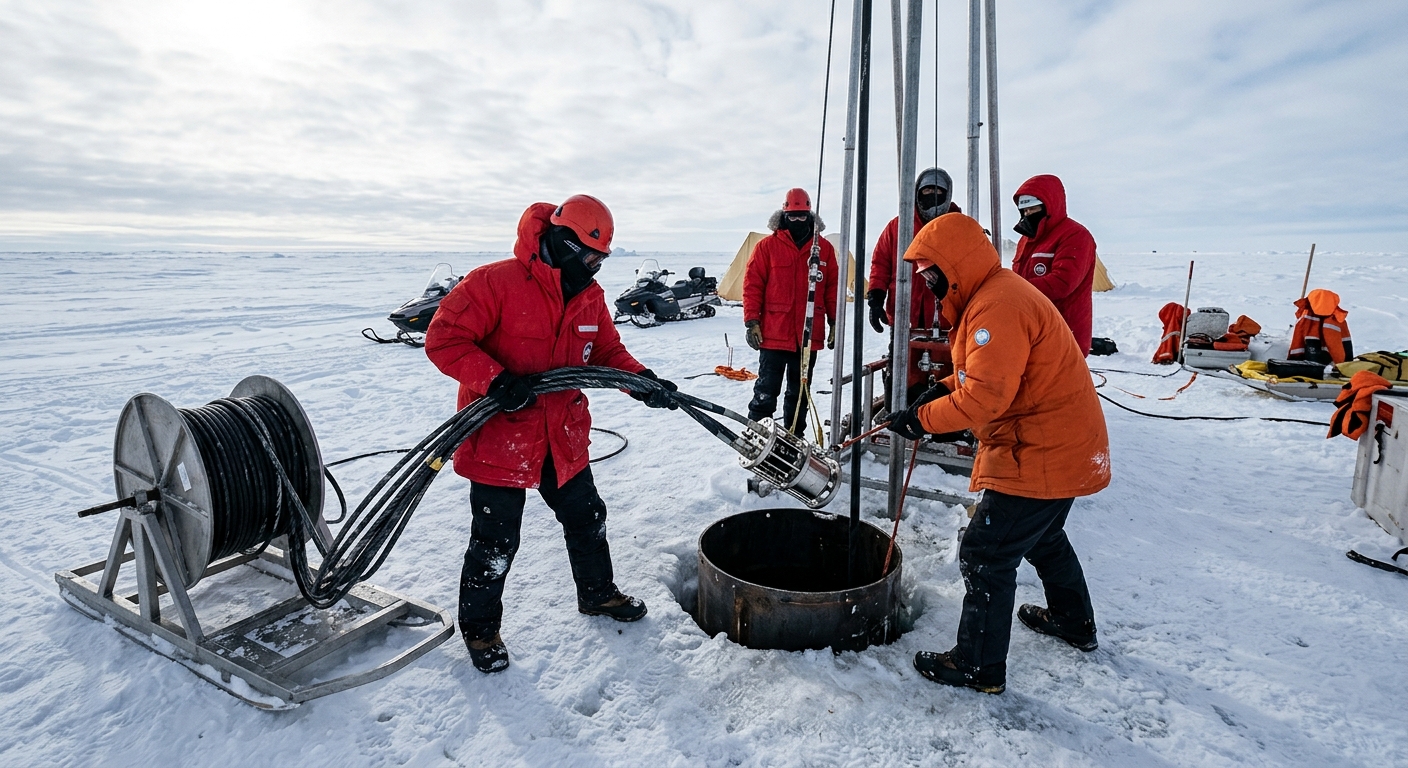
The observatory’s construction is an engineering feat. Crews use hot-water drills to bore holes a mile and a half into the Antarctic ice. They insert Digital Optical Modules (DOMs)—basketball-sized sensors—on strings into the newly formed water columns. As the water re-freezes around them, these modules become part of a vast sensor array spanning a cubic kilometer. Once completed, IceCube is set to include 86 strings of DOMs, creating an unprecedented three-dimensional telescope designed specifically for neutrino detection.
How Neutrino Detection Works
Neutrinos are high-energy subatomic particles that barely interact with matter, passing through entire planets without effect. Each second, millions traverse the human body. The IceCube observatory detects neutrinos by capturing the faint blue Cherenkov radiation produced when rare neutrino interactions occur within the ice. By tracing the direction and energy of these events, scientists can potentially map sources of cosmic phenomena like black holes, supernovas, and gamma-ray bursts.
"There's only one particle that will go through the entire earth without hitting anything, and that's a neutrino," says Mark Krasberg, a UW-Madison researcher who supervises IceCube’s operations.
Supporting Antarctic Science: Climate, Ecology, and Meteorology
The IceCube Project is only one facet of UW-Madison’s impact on antarctic science. Professor Jim Bockheim explores Antarctic soil formation amid its glacial cycles, while associate professor Christine Ribic investigates how warming and shrinking sea ice affect Adelie penguins. Emeritus professor Charles Bentley, with over 15 Antarctic expeditions since 1957, leads efforts to collect near-bedrock ice core samples for climate history research.
For atmospheric studies, Matthew Lazzara of the Space Science and Engineering Center manages more than 60 automated antarctica weather stations—about half the continent’s total. Launched in 1980, the UW-based network collects critical data for long-term antarctica climate studies, supporting research and improving operational safety for Antarctic expeditions. Weather can be extreme, with measured wind gusts up to 137 mph and temperatures plunging nearly to minus-70 degrees Fahrenheit.
Challenges and Life at the South Pole Station
Getting to the South Pole demands perseverance: a multi-day journey from the United States, usually via Los Angeles and Christchurch, New Zealand, followed by a long flight to Antarctica. Deployments often span six to eight weeks, over major holidays. South Pole Station, rebuilt for $200 million, now supports about 250 people in summer, with amenities such as a gym, greenhouse, and recreation facilities to boost morale.
Antarctic researchers face harsh conditions—from relentless cold and fierce winds to the effects of 24-hour sunlight on body clocks. Despite these challenges, international camaraderie and unique experiences—like hiking in the profound silence of the ice or meeting global peers—underscore the sense of mission and wonder central to polar research.
Looking Ahead: The Promise of Polar Astronomy
As IceCube nears completion, scientists are poised to greatly expand our understanding of the cosmos through polar astronomy and particle physics. The data already collected has begun mapping the sky for high-energy neutrino sources—an unsolved puzzle at the frontier of astrophysics. For UW-Madison and its global collaborators, the Antarctic serves as both a challenging workplace and a gateway to new scientific horizons.
Source: isthmus.com.