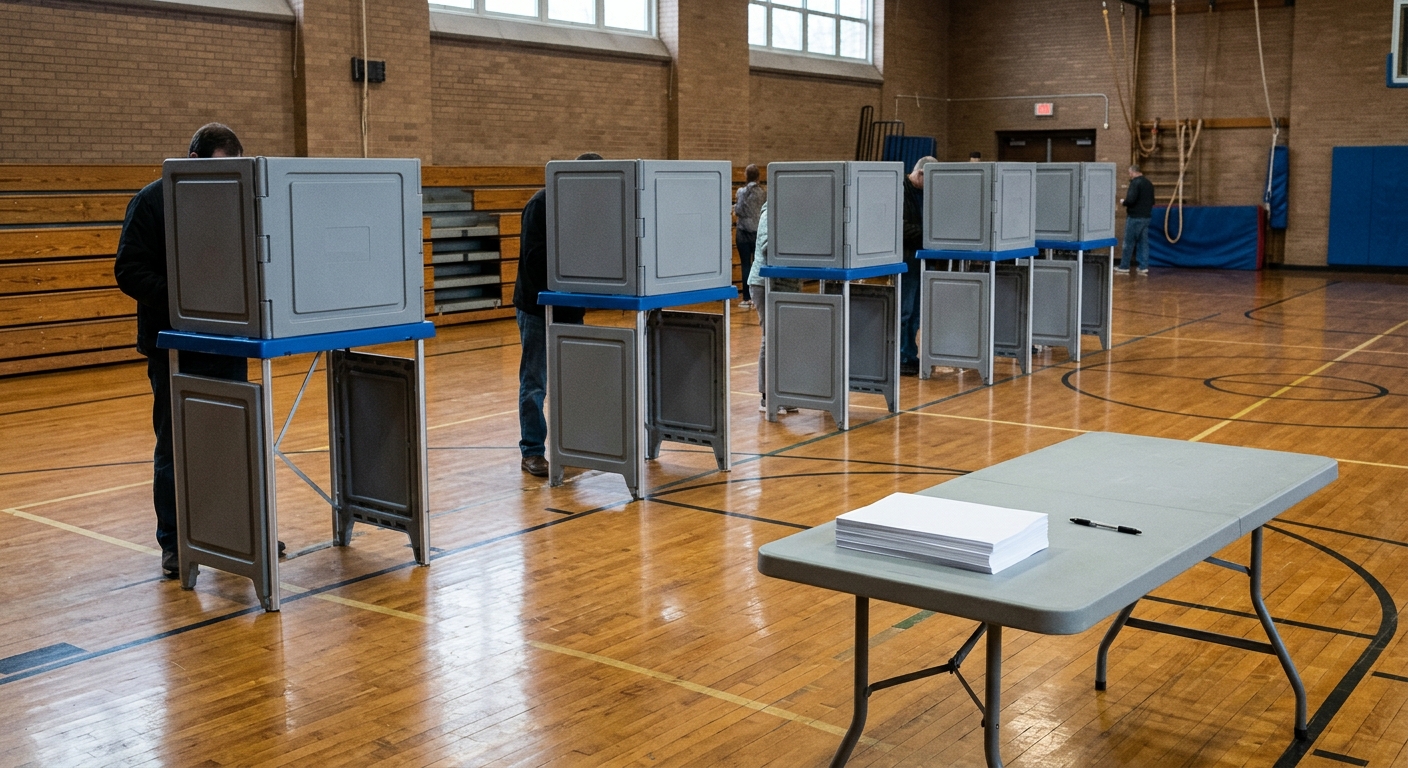
AI-generated illustration; not a photograph of the reported event.
- calendar_today November 7, 2026
Mixed Results for Three Constitutional Referendums in Wisconsin Election
In the Nov. 3 election, Wisconsin voters faced three constitutional referendums addressing the governor’s partial veto power, state discrimination policy, and public health emergency powers. The results were split: two measures passed and one was rejected.
Voter Experience and Confusion
For many voters, including Emily Calbaum who recently returned to Madison from California, the three referendums proved confusing. Calbaum described the ballot questions as “maybe intentionally misleading,” noting her uncertainty despite researching ahead of Election Day. Other voters, such as UW-Madison sophomore Michael O’Neill, echoed concerns about unclear wording, which made it difficult to discern the implications of a “yes” or “no” vote.
Partial Veto Powers Restricted
The first approved amendment, with 50.7% support, restricts the governor’s ability to use partial veto powers to create or increase taxes and fees. This change arose partly in response to a 2023 budget maneuver by Governor Tony Evers, who used his veto authority to extend per-pupil funding increases for centuries by altering legislative text. Although the move was challenged in court, the Wisconsin Supreme Court upheld Evers’s veto in a close 4-3 decision in 2025.
Rick Esenberg, executive director of the conservative Wisconsin Institute for Law & Liberty, supported the amendment and argued most citizens oppose broad veto powers that significantly alter legislative intent. Debra Cronmiller of the League of Women Voters, which urged "no" votes, noted the amendment’s appeal may stem from widespread opposition to new taxes, though she sees the issue as more complex.
Discrimination Amendment Passes
The second amendment, prohibiting "discrimination" and "preferential treatment" in state government, was approved by 56.4% of voters. The Wisconsin Institute for Law & Liberty advocated for this change as well, with Esenberg stating that people support treating individuals rather than groups.
Opponents of the measure, including Nick Ramos of the Wisconsin Democracy Campaign, argued that the amendment’s wording made it easy to misconstrue as being simply against discrimination, but could in fact undermine diversity, equity, and inclusion (DEI) efforts. Cronmiller suggested that the confusing language may have influenced voters to support measures that could reduce equity in access and opportunity.
Public Health Powers Amendment Defeated
The only measure to fail was a proposed amendment limiting public health officials’ emergency powers, especially regarding the closure of religious institutions. It was defeated by 52% of voters. Cronmiller observed that this question was easier for voters to understand, and faith leaders played a significant role in informing their communities about potential consequences, expressing the view that public health decisions should not be legislated away from experts.
Esenberg attributed the measure’s defeat in part to its association with partisan politics in an election cycle favoring Democrats. Cronmiller and Ramos both criticized the use of constitutional amendments for controversial policy proposals that might not survive executive vetoes.
Context and Legislative Trends
Since 2023, Wisconsin voters have considered 11 constitutional amendments. Republican lawmakers have notably used amendments—immune to gubernatorial vetoes—more frequently than standard legislative bills. Amendments require passage in two consecutive legislative sessions and majority voter approval.
Cronmiller hopes the results will encourage the Legislature to focus on representing the electorate. Ramos maintains that recent amendments do not advance the public good, but rather solidify contentious policies.
Looking Forward
The results of the Nov. 3 election affirm that Wisconsin voters remain engaged with constitutional changes affecting state government, though concerns about ballot clarity and the purpose of proposed amendments persist. As political parties continue to pursue policy via constitutional measures, voter understanding and engagement will remain central issues in Wisconsin’s evolving legislative process.
Source: isthmus.com.